If you’ve been researching rugged tablets for your UTV or ADV bike, you’ve almost certainly seen MUNBYN come up. They’re a legitimate rugged tablet brand — solid hardware, reasonable prices, good reputation in their target market.
Their target market is warehouses, construction sites, and field service operations. Not UTV trails.
This isn’t a takedown. MUNBYN makes good industrial tablets for the environment they were designed for. The point of this comparison is to lay out, spec by spec and use case by use case, why powersports creates requirements that industrial tablets weren’t built to meet — and what those differences look like in practice.
What MUNBYN Is (And Who It’s Actually Built For)
MUNBYN was founded in 2015 and has built a solid catalog of industrial rugged tablets. Their lineup is primarily Windows and Android devices built for construction sites, warehouses, logistics operations, and field technicians.
Their own positioning language says it directly: “Ideal for warehouses, factories, field service, and outdoor work.” The target customer is a construction supervisor who needs a device that survives a drop off a workbench and can be read under a site awning.
MUNBYN’s ILT02 Android model appears on Amazon with “UTV” in the listing title. Worth acknowledging. But reading through the specs, it’s the same industrial Android platform aimed at field workers, applied to a search term. That’s a keyword decision, not a design decision.
That distinction matters when you’re deciding which device belongs mounted on your machine.
Display Brightness: 2,600 Nits vs. 650–1,000
This is the most significant performance gap between the two platforms, and it’s the one you’ll feel on every ride.
MUNBYN’s lineup runs from 650 nits on most models (IRT08, IRT09 series) up to 1,000 nits on their top-of-line IRT12 Windows tablet. That 1,000-nit figure represents their best outdoor visibility, achieved on a Windows device running around $400.
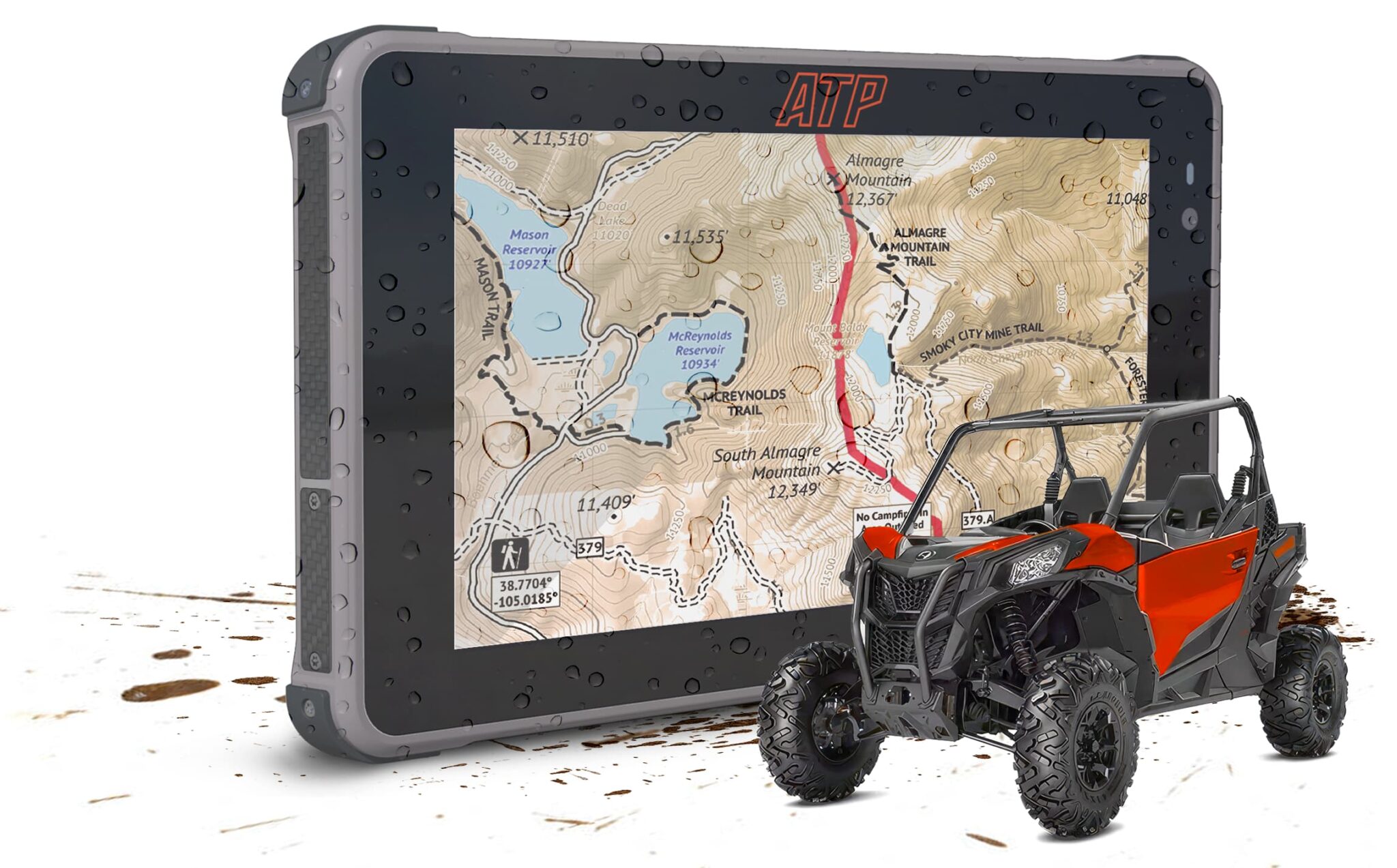
ATP Rugged runs at 2,600 nits — 2.6x brighter than MUNBYN’s best model, and roughly 3.7x brighter than the 700-nit models in the middle of MUNBYN’s catalog.
What this means in practice: you’ll read an ATP display clearly in full midday desert sun without adjusting your approach. A 700-nit display in the same conditions is readable in shade and marginal in direct sun. A 1,000-nit display performs better but still requires ideal positioning to read comfortably at noon in Glamis or on Colorado high-country routes.
For UTV and ATV riding, where you’re continuously in direct sun and can’t reposition the display without stopping, the brightness gap is the deciding factor.
Mounting: Purpose-Built vs. Industrial Afterthought
MUNBYN tablets ship with compatibility for industrial mount hardware — forklift cradles, fleet truck vehicle docks, fixed industrial station mounts. Most of this hardware isn’t built around the AMPS mounting pattern that the powersports aftermarket runs on.
Getting a MUNBYN into a UTV cab means sourcing third-party adapters, fabricating hardware, or using adhesive solutions — none of which are designed for sustained vehicle vibration.
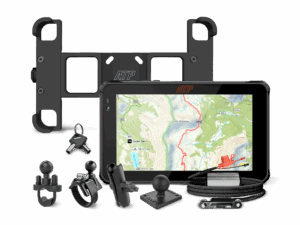
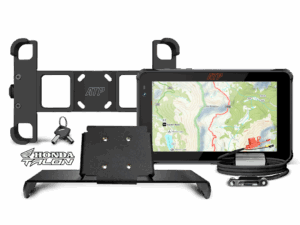
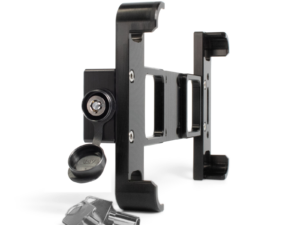
The ATP Rugged mount kit is AMPS-compatible out of the box. It integrates with standard UTV aftermarket hardware, includes vibration isolators for sustained mechanical vibration, and comes with a security cable. It’s a complete vehicle integration system, not a tablet that happens to have mount holes on the back.
GPS: Built-In Multi-GNSS vs. Connectivity-Dependent Performance
Both platforms offer GPS, but the implementation matters in the conditions where you actually ride.
MUNBYN’s Android models have GPS receivers that rely on assisted GPS (A-GPS), which performs best with cellular or Wi-Fi connectivity for quick satellite data acquisition. In cellular dead zones — exactly where most serious trail riding happens — initial lock acquisition can be slow, and the receiver may struggle to reacquire after signal interruptions.
The ATP Rugged system uses multi-GNSS (GPS + GLONASS + Galileo) with full standalone offline capability. Position acquisition in remote areas is designed to function without any cellular connection. For navigation deep in canyons, high desert, or mountain terrain where there’s no signal for hours at a stretch, this matters more than any other GPS spec on the sheet.
Heat and Thermal Management for Powersports Conditions
“Outdoor” means different things depending on the use case.
For an industrial worksite, outdoor means an uncovered construction site or a fleet vehicle parked in a loading dock. Ambient temperatures may push into the 90s on a hot day. That’s the design target for MUNBYN’s thermal specifications.
For a UTV in desert summer riding, you’re looking at 100°F+ ambient temperature, direct solar radiation heating the device’s housing, continuous processor load from GPS navigation and mapping, and sustained operation for six or more hours. The cumulative thermal load is substantially higher than anything an industrial worksite generates.
The ATP Rugged is specifically tested for powersports thermal conditions. The difference shows up in summer desert riding when industrial tablets throttle back or shut down to protect their processors — and ATP stays running.
Warranty and Support: What the Experience Is Actually Like
MUNBYN offers a 2-year standard warranty with enterprise extension options. Their support infrastructure is built for B2B buyers — IT departments managing fleet devices, not individual riders troubleshooting a field issue mid-trip.
ATP Rugged offers warranty and support specifically designed for powersports users buying direct. When something goes wrong, the support experience is built for a rider calling from the garage, not a procurement manager submitting a ticket.
Side-by-Side Spec Comparison
|
Spec |
ATP Rugged |
MUNBYN (Standard Range) |
MUNBYN IRT12 (Best Model) |
|
Display Brightness |
2,600 nits |
650–700 nits |
1,000 nits |
|
IP Rating |
IP68 |
IP65–IP67 (varies by model) |
IP65 |
|
MIL-STD-810G |
Yes |
Yes (most models) |
Yes |
|
Mount System |
AMPS-compatible, vibration-isolated |
Industrial dock hardware |
Industrial dock hardware |
|
GPS Type |
Multi-GNSS standalone |
A-GPS (connectivity-assisted) |
A-GPS |
|
Operating System |
Android |
Android or Windows |
Windows |
|
Design Target |
Powersports vehicles |
Industrial / field service |
Industrial / field service |
|
Primary Market |
UTV / ADV / Overlanding riders |
Construction, logistics, warehousing |
Construction, logistics, warehousing |
See the full ATP Pro Pack specs
The Bottom Line: Which One Belongs in Your UTV?
If you need an industrial tablet for warehouse inventory management or field engineering work, MUNBYN is worth serious consideration. Good hardware, reasonable prices, solid enterprise support.
For a UTV, ADV motorcycle, or overlanding rig: ATP Rugged was built for that environment and MUNBYN wasn’t. The brightness gap is real and shows up on every sunny ride. The mounting system difference is real and affects installation quality. The thermal performance and GPS differences are real and affect summer desert use specifically.
Both tablets run Android. Both have GPS. Both carry MIL-STD-810G certification. The specs that matter for powersports — nit count, vibration-rated mount, sustained thermal performance, standalone offline GPS — point clearly in one direction.
Frequently Asked Questions
Is MUNBYN good for off-road use?
MUNBYN makes solid industrial rugged tablets designed for construction, logistics, and field service environments. They’re built for outdoor worksite conditions, not powersports. The main limitations for off-road riding are display brightness (650–1,000 nits vs. 2,600 nits on ATP), lack of AMPS-compatible powersports mounting, and thermal performance designed for worksites rather than sustained desert trail use.
How does ATP compare to MUNBYN for navigation?
Both run Android with GPS capability. ATP’s multi-GNSS standalone offline GPS is designed for deep backcountry use without cellular signal, and the 2,600-nit display is readable in the conditions where navigation matters most — direct sun, at speed, without stopping.
What’s the difference in brightness between ATP and MUNBYN tablets?
MUNBYN’s standard models run 650–700 nits. Their top-of-line IRT12 Windows model reaches 1,000 nits. ATP Rugged runs at 2,600 nits — 2.6x to 4x brighter depending on which MUNBYN model you’re comparing.
Can I use MUNBYN with onX or Gaia GPS?
Yes, on Android models. Both platforms run Google Play, so navigation apps install on either device. The brightness difference affects how readable those apps are in direct sunlight, and the mounting system difference affects how securely either device stays positioned over rough terrain.
Is ATP Rugged worth the price difference over MUNBYN?
For powersports use, yes. The brightness gap alone has practical implications on desert and mountain riding where display readability affects navigation decisions. The complete mounting system, sustained thermal performance, and purpose-built standalone GPS capability also factor in. The price premium reflects real performance differences in the environment you’re actually riding in.